
Darcy Watkins
Why you may need this for a hardware based keyboard stack, and how to modify a Roland DP-10 sustain pedal to have two electrically isolated outputs to feed into two keyboards.
If you stack hardware keyboards and use the hardware sound generators (rather than use DAWs to generate sounds in software), you may encounter issues with some vintage / legacy keyboards where sustain pedal action is not affecting all your sounds as you would like. The solution in many cases can be to modify a sustain pedal to have two outputs.
The problem is simply that many keyboards will filter sustain events from a different source from where the note events come. For example, you play keyboard 1 and MIDI to keyboard 2. If the pedal is plugged into keyboard 1, all is ok, but if the pedal is plugged into keyboard 2, the pedal action, although it will sustain locally played notes on keyboard 2, it will not sustain the noted received via MIDI.
This is true for many keyboard even if they use the same MIDI channel.
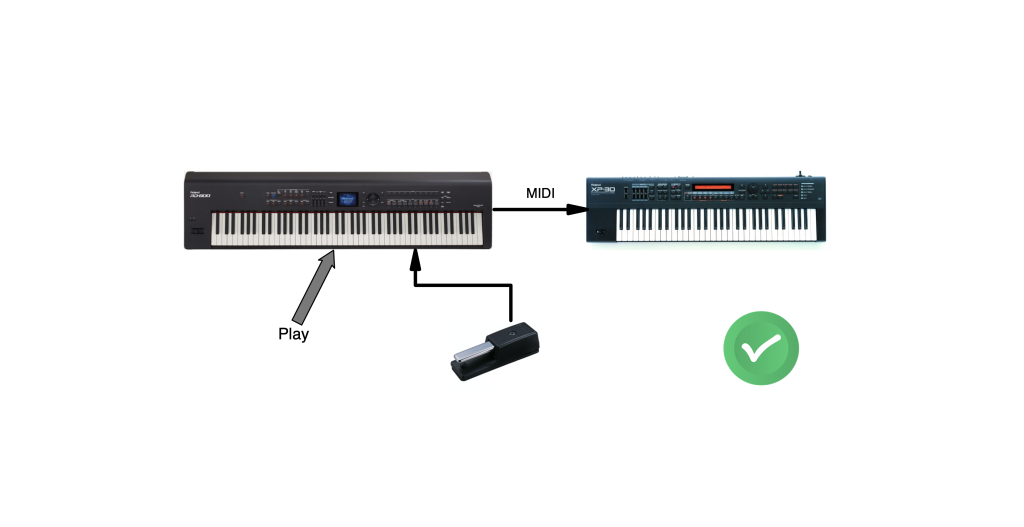
Above shows notes and sustain via same source, MIDI. Below shows them from different sources.
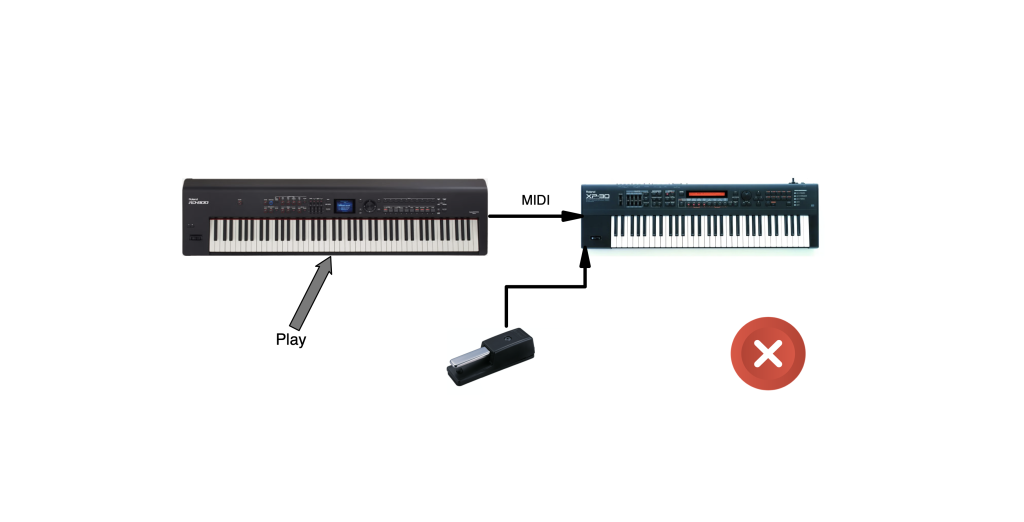
Some older keyboard may even exhibit this same behaviour for all CC message, not just sustain. For example, Roland XP-30 (and others of the same generation) exhibit this behaviour, but only for sustain. But an earlier generation Roland JV-80 exhibits this behaviour for all CC messages, after-touch and pitch bend.
I believe (and this is strictly speculation) that this comes from how multi-timbral synthesizers came out, how they evolved and the early use cases related to playing along with sequencers, real time accompaniment, perhaps even arpeggiators. Someone made a design decision that it was better to unconditionally implement a filter than to have pedal action affect parts they were not intended to touch (and they decided to NOT give the user any choice over this in instrument settings).
If the issue only affects sustain (such as for the XP-30 synth) then a relatively simple solution is to use two ganged sustain pedals. But I doubt anyone wants a “duct tape special” ganged sustain pedal. Some options that work functionally, but may introduce ground loop hums are…
- A “Y” cable.
- Using both sides of an SPDT switch (if that is what is inside the pedal).
Options that work are:
- Replace a SPDT (or SPST) switch with a DPDT (or DPST) switch.
- Break out a pedal that supports continuous or discrete modes (using a selector slide switch) into each a continuous and the discrete output.
I have done both of these. Replacing a SPDT switch with a DPDT switch involves a lot of hacking and drilling on a tiny PCB, so it’s not for the faint of heart. Come to think of it, neither of these are for the faint of heart.
I took a Roland DP-10 and separated the continuous and the discrete control sources, isolated them (to avoid ground loop hum) and output each via its own cable. So I have the modified DP-10 pedal with two wires coming out of it.
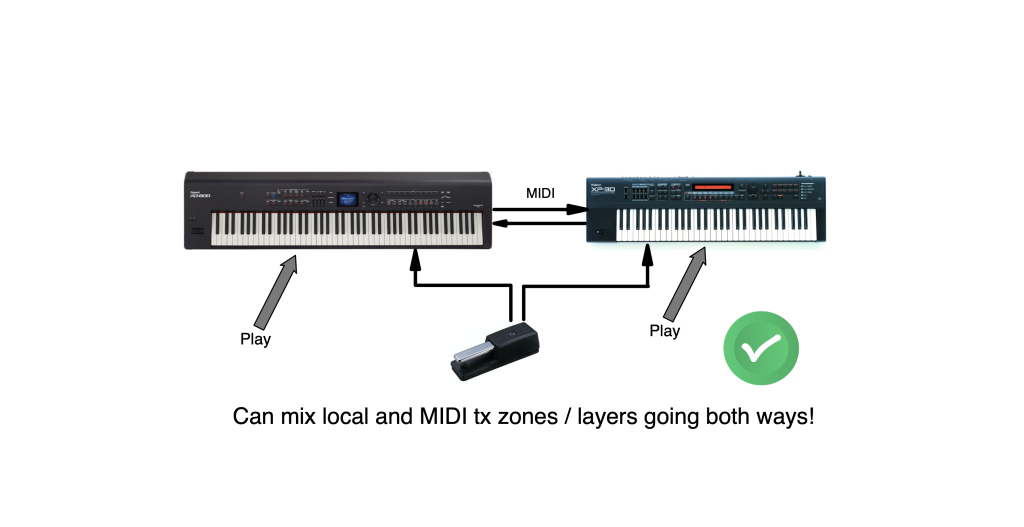
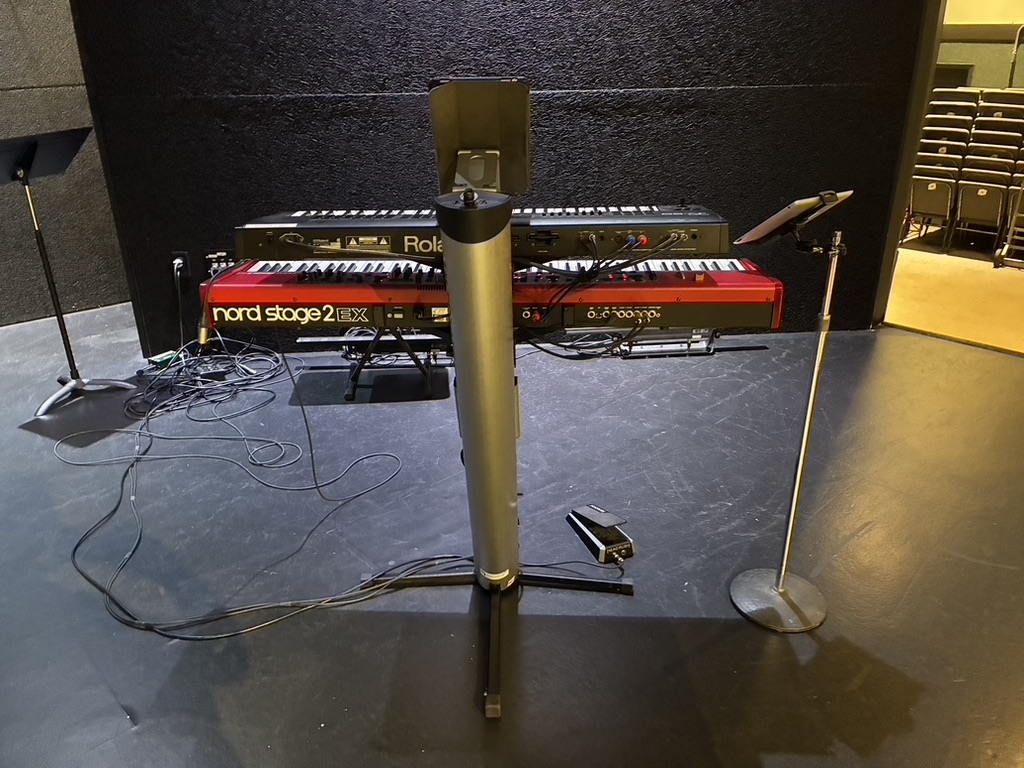
So in my setup involving either a Roland RD-800 or a Nord Stage 2 on bottom tier, and a Roland XP-30 or a Roland JV-80 as the top tier, I can MIDI both ways and map out zones on each keyboard that supports combos of local with MIDI tx and rx parts.
This gives me close to what can be handled using a DAW such as MainStage, Ableton Live, GigPerformer or Reaper.
So now how to do it? See it on YouTube.
Enjoy!